January 15, 1969
Table of Contents
-
p. 20
The Conversion To SSB Communications Requires A Major Equipment Change
A. E. Anderson of Collins Radio explains why the mandated shift from AM to single sideband forces an overhaul of maritime radio equipment: because SSB suppresses the carrier, receivers must reinsert it within a few cycles, demanding far tighter frequency accuracy than AM's loose tolerances. Meeting the FCC's plus-or-minus 20 Hz coast station requirement means roughly 0.73 ppm at 27.5 MHz, which makes a separate crystal per channel impractical beyond six or eight channels. He argues the frequency synthesizer approach wins above roughly 20 to 30 channels, offering one calibrated reference oscillator, uniform stability and immediate access to every channel.
-
p. 38
National Steel And Shipbuilding Company's Modernization: The System At NASSCO Works
Nassco completed a modernization program that more than doubled its shipbuilding capacity while cutting the direct steel-handling force from 20 men to seven at a much higher throughput. Constrained to its existing steel yard and plate shop with no new land, the yard added a flame planer and beam welder and tied everything together with a seven-section Via Nova conveyor system moving material rapidly, continuously and along preselected lines at 100 fpm. The centerpiece is the Collocator, a mobile unit on 1,000 feet of track serving 18 stations, freed from messenger cables by crane-type conductors with multi-frequency control signalling, all directed from an elevated central control tower.
-
p. 56
A New King On The Pacific Coast
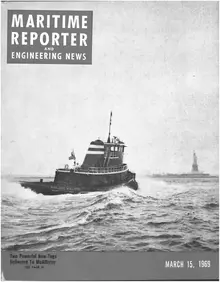
Island Tug & Barge has added the 3,600-hp Island King to its fleet under a $4,000,000 construction program, following hull model testing at the Netherlands Ship Model Basin. Designed by Robert Allan Ltd. and built by Star Shipyard, the 131-foot tug pairs a 20-cylinder GM 20-645 E-5 with a Kort nozzle for a 100,000-pound bollard pull, confirmed on trials along with 14.5 knots. She carries air-conditioned individual cabins, an all-electric galley, 50 days' endurance and a Sperry gyro autopilot, and works the largest offshore barges on the Pacific Coast.
-
p. 12
Reduced Costs Are Possible With Total Power Systems
R. S. Ramsey of GM's Electro-Motive Division argues that mass-produced medium and high speed diesels, drawn from locomotive, oil drilling and utility practice, let designers assemble flexible multi-function marine powerplants at low first cost. He illustrates a cargo-ship unit in which two 3,600-bhp diesels drive through generators into a common reduction gear delivering 7,000 hp to a controllable-pitch propeller. A block diagram shows a 14,000-shp self-unloading ship where air clutches release engines from the propellers so their generators can drive thrusters and unloading machinery.
-
p. 52
Tatco Delivers Tuna Clipper First Of New 83-Foot Class
Tatco Shipbuilding of San Diego has delivered the Tropicana, first of a new class of 83-foot steel tuna clippers with a bulbous bow adapted by naval architect Elmer Olson from large tanker practice. On December trials the fully loaded boat made 10.5 knots below rated engine speed and handled well enough that builder and owner called the hull design outstanding, with reduced pitch, roll and yaw. The $240,000 vessel carries 126 tons of frozen fish and a crew of ten in air-conditioned quarters.
-
p. 6
First New York/Dominican Republic Roll-On Service Started With MS Caribbean Venture
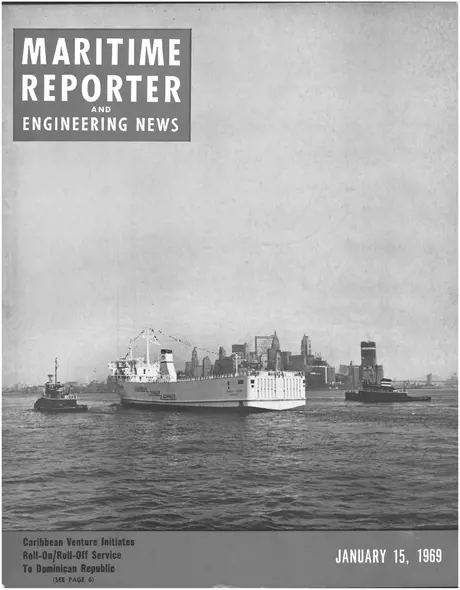
Caribbean Trailer Express Line began the first roll-on/roll-off service from New York to Jamaica and the Dominican Republic in December, using the 309-foot, 2,300-dwt MS Caribbean Venture on a fortnightly schedule. Built by J.J. Sietas in Germany for shallow-draft fast turnaround, the ship carries 51 forty-foot trailers plus two 180-ton deep tanks, loading via a 45-foot stern ramp and a 33-ton scissor elevator to the weather deck. Twin Deutz diesels of 2,000 bhp each give 16 knots; a sistership, Caribbean Enterprise, arrives in February to make the service weekly.
-
p. 48
Ingalls And Kockums Sign Technical Exchange Agreement
Ingalls Shipbuilding and Sweden's Kockums have signed a technical exchange agreement sharing experience and technological developments between the two yards. Kockums chairman Lars-Erik Thunholm said the arrangement lets his firm participate in advances being built into Ingalls' new $130-million assembly-line shipyard at Pascagoula, due in production by 1970. The agreement also covers personnel exchanges and on-site inspections, subject to government security restrictions.
-
p. 10
Tenneco Appoints Ackerman President Of Newport News Ship
Tenneco has named L. C. Ackerman president and chief executive officer of Newport News Shipbuilding, joining chairman Donald A. Holden in running the yard, with Thomas G. Cook succeeding Ackerman as president of Walker Manufacturing. President N. W. Freeman framed the reassignments as a response to the growing complexity of Tenneco's manufacturing operations. Ackerman spent 16 years with Walker Manufacturing and had served on the Newport News board since September.
-
p. 26
Luckenbach Urges Shipbuilding Program Of 100 Ships Per Year
Speaking to the Propeller Club's Jacksonville chapter, Edgar F. Luckenbach Jr. urged mass production of standardized, frill-free cargo vessels as a central national maritime policy objective, achievable with little modification to existing yards. He proposed assigning each yard a tonnage class so yards could average ten ships a year, provided they are assured of financing for facility improvements. He noted 750 of the nation's 900 commercial vessels have little life expectancy left, and cited President-elect Nixon's pledges on cargo share and a 100-ship-per-year program.
-
p. 52
MarAd Offers Savannah For Long-Term Charter
The Maritime Administration has invited U.S.-flag operators to propose long-term operation of the nuclear ship Savannah, by bareboat charter from about July 1969, outright purchase or another arrangement. The government currently spends roughly $3.3-million a year on operation, support and crew training and wants to reduce or eliminate that burden. MarAd suggests revenues could rise through container capability, a midbody insertion or automation, and notes the recently refueled ship has five to six years of nuclear fuel remaining.